Earn a monthly salary while mastering a certified profession in Germany.
The German Dual Vocational Training System (Duales Ausbildungssystem) combines paid corporate employment (3–4 days/week) with state-funded classroom theory (1–2 days/week)—producing a world-class certified workforce with zero tuition fees.


The Core Concept: Real Work Meets Academic Rigor
Unlike traditional university degrees consisting solely of lecture halls, the trainee (Auszubildender or colloquially “Azubi”) alternates continually between two interlinked learning spheres throughout the entire program.
5-Day Split: Corporate Workplace & Public Vocational College
Host Company Practical Training
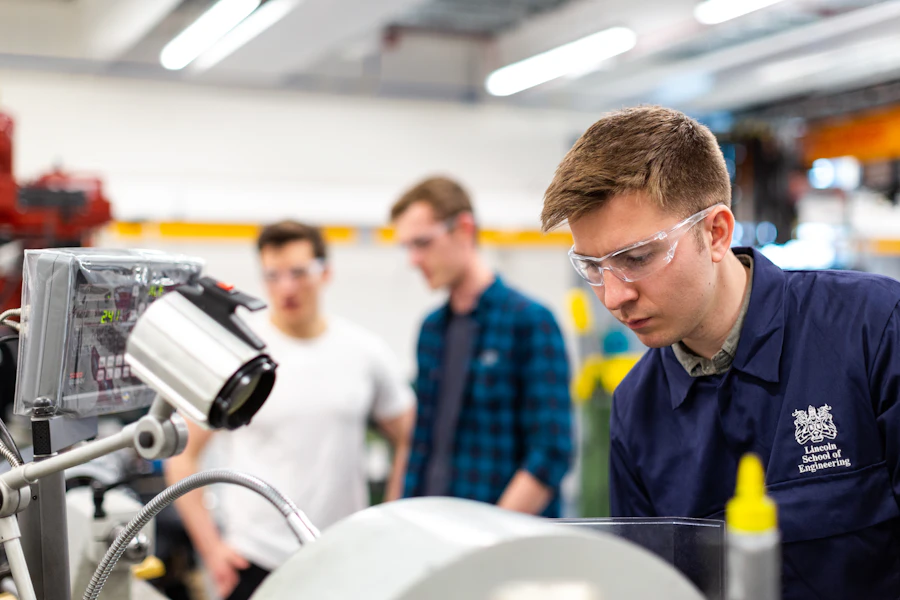
Hands-on industrial work, machinery operation, live software coding, or patient care supervised by a certified Master Craftsperson (Meister).
Vocational School (Berufsschule)
Specialized theoretical foundation, technical mathematics, economic law, and core business communication.
ENVIRONMENT 01: THE WORKPLACE1. The Workplace (Host Company — 3 to 4 Days/Week)
Trainees are fully contracted employees who spend the majority of their week performing genuine corporate tasks. Under the dedicated mentorship of certified instructors and Master Craftspersons (Meister), apprentices learn industry-standard workflows, health and safety, and operational excellence.
- Real-world machinery, client software, and operational facilities
- Company-funded toolkits, protective equipment, and software licenses
- Mentorship from certified German vocational trainers (AEVO qualification)
 ENVIRONMENT 02: THE VOCATIONAL SCHOOL
2. The Vocational School (Berufsschule — 1 to 2 Days/Week)
The academic counterpart to practical experience. Trainees attend publicly funded vocational colleges where accredited educators instruct them in trade-specific scientific principles, engineering mathematics, applied physics, and core civic education.
- 100% publicly funded with zero tuition charges to the trainee
- Classes divided into trade theory (approx. 60%) and general academics (40%)
- Preparation for the nationwide Chamber of Commerce (IHK/HWK) examinations
Full Employee Rights & Nationally Standardized IHK/HWK Credentials
An Azubi is legally classified as an employee under the German Vocational Training Act (Berufsbildungsgesetz - BBiG), enjoying statutory protection, monthly earnings, and social insurance.
1. Vocational Training Contract (Ausbildungsvertrag)
A legally binding contract signed directly between you and your host company, approved and registered with the competent regional Chamber (IHK or HWK) before visa application.
2. Progressive Monthly Allowance (Ausbildungsvergütung)
Paid directly by your company every single month of the program. By law, this stipend increases automatically with every completed year of your training.
3. Full Social Security & Health Insurance Integration
Trainees are immediately integrated into the German statutory healthcare, nursing care, unemployment, and state pension insurance systems from Day 01.
Standardized National Examination & Portability
Depending on the complexity of the trade and prior academic qualifications (e.g. holders of Abitur/Intermediate can often shorten training by 6 months with good performance).
Crucially, your training company does not examine you. Final practical and theoretical exams are conducted by independent boards of the Industrie- und Handelskammer (IHK) or Handwerkskammer (HWK) comprising employers, vocational teachers, and union representatives.
The resulting Gesellenbrief or Facharbeiterbrief guarantees that you meet the exacting national standards of German industry. Employers nationwide and across the EU recognize your exact competency level instantly.
Career Track & Ausbildungsvergütung Explorer
Select a certified German vocational career track to preview verified statutory monthly allowances.
Mechatronics Technician
Interdisciplinary masters of mechanical, electrical, and computer control systems. You will assemble, program, calibrate, and maintain complex robotics and automated production machinery across Germany’s manufacturing backbone.
The Tripartite Governance Model
Why does Germany have one of the lowest youth unemployment rates in the developed world? Because the Dual System is co-governed by three institutional partners whose interests align perfectly.
The German Government
The Federal Government sets the overarching legal framework (BBiG), while the 16 German Federal States (Bundesländer) fully finance, operate, and staff the public vocational schools (Berufsschulen).
The Private Sector (Companies)
German enterprises treat apprentices as future core personnel. Companies invest in modern training machinery, provide certified instructors, and pay the trainee’s monthly allowance voluntarily to secure tomorrow’s workforce.
Social Partners (Chambers & Unions)
The Chambers of Commerce (IHK) and Crafts (HWK) regularly update curricula alongside trade unions so that training directly mirrors the latest advancements in artificial intelligence, green energy, and precision automation.
Transformative Advantages for Candidates & Global Industry
Why the German model is universally studied and adopted: immediate student financial self-reliance paired with enterprise-grade talent development.
Zero Student Debt, Guaranteed Earnings, and Permanent Career Pathways
100% Free Tuition & Monthly Income
Say goodbye to university debt. Your vocational school is fully subsidized by the German state, and your host enterprise pays you a living wage from month one.
~70% Immediate Permanent Employment
Because host companies invest tens of thousands of Euros in your apprenticeship, roughly 70% of graduates are offered open-ended, full-time contracts right after their IHK exam.
Career Advancement: Master (Meister) or University
A dual vocational qualification is not a dead end. Graduates can pursue a Master Craftsperson (Meister) title—which holds the same legal standing in Germany as a Bachelor’s degree—or transition into higher education.
Standardized Excellence, Zero Skills Mismatch & Turnkey Placement
Flawless Quality Assurance
Every certified Mechatronics Technician or Electronics Specialist in Germany is verified by uniform state and Chamber examinations. Quality is absolute and non-negotiable.
Zero Skills Gap
Unlike generic classroom graduates, an Azubi knows your machinery, your company culture, and your safety procedures from day one of permanent hiring.
Supported by Prolex Study & Prolex Recruitment
Operating in synergy with Prolex Recruitment, we source, pre-vet, and linguistically prepare qualified global candidates for German corporate apprenticeship cohorts.
Statutory Entry Requirements for Non-EU Applicants
Applying from outside the European Union requires compliance with three mandatory criteria established by the German Federal Ministry of the Interior and the Federal Employment Agency (Bundesagentur für Arbeit).
1. School-Leaving Certificate
Minimum equivalent of German Hauptschulabschluss (10 years) or Realschulabschluss / Abitur (12 years: FSc, FA, A-Levels, or technical diploma).
2. B1 or B2 German Certificate
Mandatory official certificate (Goethe-Institut, ÖSD, or telc). All vocational school instruction and national IHK exams are conducted strictly in German.
3. Vocational Training Visa
Secured via Section 16a of the German Residence Act (AufenthG). Involves labor-market priority approval by the Federal Employment Agency.
Interactive Azubi Readiness Checker
Configure your academic background and current language qualifications to evaluate your visa readiness and pathway timeline.
Ready to secure your German Dual Vocational Training Contract?
Speak with a senior German education and vocational advisor at Prolex Study to evaluate your high school diploma, plan your German B1/B2 training, and match with verified German corporate employers.